
The OARSI 24-hour movement guidelines initiative is developing the first international evidence-informed 24-hour movement guidelines for adults with lower-extremity osteoarthritis. The project brings together researchers, healthcare professionals, guideline methodologists and people living with osteoarthritis to develop practical recommendations on physical activity, sedentary behaviour and sleep.
What are 24-hour movement guidelines?
Everyone has the same 24 hours in a day, and the time spent sleeping, sitting, standing, walking and exercising is interconnected. Spending more time in one behaviour necessarily leaves less time for another. The 24-hour movement framework therefore considers physical activity, sedentary behaviour and sleep together, recognising their combined influence on health and wellbeing.
Over the past decade, several countries, including Canada and Australia, have incorporated this concept into national 24-hour movement guidelines for different age groups and populations. These guidelines integrate recommendations for physical activity, sedentary behaviour and sleep within a single framework, encouraging a healthy balance of movement behaviours across the entire day rather than focusing on exercise alone. However, no international 24-hour movement guidelines have yet been developed specifically for people living with osteoarthritis.
Why are osteoarthritis-specific guidelines needed?
Although existing 24-hour movement guidelines provide valuable recommendations for the general population, they do not fully address the needs of people living with osteoarthritis. Pain, stiffness, fatigue, sleep disturbance, and reduced mobility can influence how people distribute physical activity, sedentary behaviour, and sleep across the day. General advice to be more active or sit less may therefore need to be balanced with symptom management, recovery, activity pacing, and individual preferences.
Important questions remain unanswered, including how much and what intensity of physical activity may be most beneficial, how much uninterrupted sitting is too much, what role sleep plays in osteoarthritis-related health, and how reallocating time between movement behaviours may affect outcomes. Currently, healthcare professionals and people living with osteoarthritis have limited evidence-informed guidance on how these behaviours should be balanced across the day.
The OARSI 24-hour movement guidelines aim to address this gap by developing recommendations focused on outcomes that matter to people with osteoarthritis, including pain, physical function, quality of life, fatigue, overall wellbeing, and potential adverse effects.
How will the guidelines be developed?
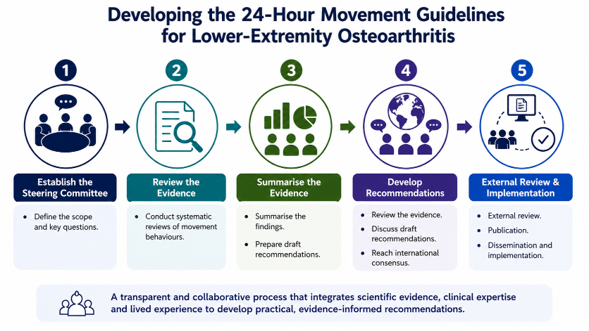
The guidelines are being coordinated by an international steering committee with expertise in osteoarthritis, movement behaviour, guideline development, evidence synthesis, and consumer engagement. The committee oversees the project and ensures that people living with osteoarthritis contribute throughout the development process.
Evidence will be drawn from systematic reviews examining physical activity, sedentary behaviour, sleep, and combinations of these behaviours in people with lower-extremity osteoarthritis. The evidence will be considered alongside clinical expertise and the perspectives of people living with osteoarthritis to develop draft recommendations. An international multidisciplinary guideline development panel will then review the evidence, discuss the draft recommendations and agree on the final recommendations. The recommendations will subsequently undergo external review before being finalised. The proposed development structure is shown below.
Project timeline
The initiative commenced in 2026 with the establishment of the steering committee and development of the guideline scope and research questions. Four systematic reviews are underway and are expected to be completed during 2026–2027, followed by evidence synthesis, recommendation development and deliberation by the international guideline development panel.
Draft recommendations are expected to undergo external review and refinement during late 2027 and early 2028. Publication of the final guidelines and supporting implementation resources is planned for 2028. The timeline is indicative and may be adjusted as the work progresses.
Who is involved?
The initiative is guided by an international steering committee comprising researchers, clinicians, guideline experts and people with lived experience of osteoarthritis from Australia, Canada, China, Denmark, the United Kingdom and the United States. An international guideline development panel will also be convened to review the evidence and contribute to the development of the recommendations.
The full steering committee is listed below.
- Michelle Hall — Chair, The University of Sydney, Australia
- Daniel K. White — Deputy Chair, University of Delaware, United States
- Linda C. Li — The University of British Columbia and Arthritis Research Canada, Canada
- Boliang Wang — The University of Sydney, Australia
- Gillian Hawker — University of Toronto, Canada
- Robin Christensen — University of Southern Denmark and the Parker Institute, Denmark
- Joshua F. Baker — University of Pennsylvania, United States
- Melanie A. Holden — Keele University, United Kingdom
- Ryan S. Falck — The University of British Columbia, Canada
- Siyi Zhu — West China Hospital, Sichuan University, China
- Dorothea Dumuid — Adelaide University, Australia
- Monserrat Conde — University of Oxford, United Kingdom
- Jillian Eyles — The University of Sydney, Australia
- Mengyun Luo — The University of Sydney, Australia
- Sandra Crone — Patient partner, Australia
- Trish Silvester-Lee — Patient partner, Arthritis Research Canada, Canada
Contact us
For enquiries about the OARSI 24-Hour Movement Guideline Initiative, please contact:
Associate Professor Michelle Hall
The University of Sydney, Australia
Email: michelle.hall@sydney.edu.au
This page will be updated as the guideline development process progresses.